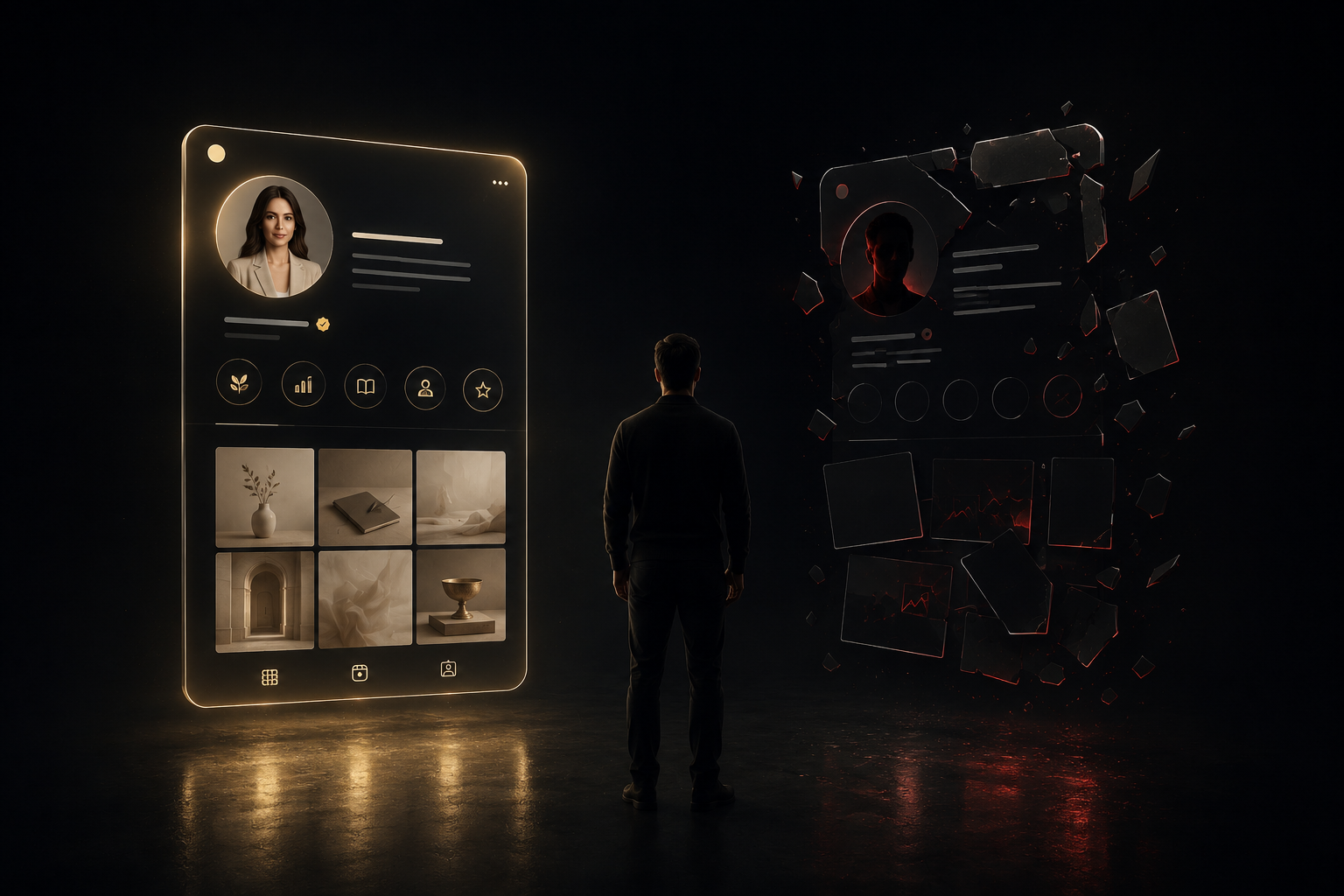
Why People Visit Your Profile but Don't Buy
You can post every day, offer a great product, lower prices and genuinely want to help people, yet still struggle to make sales. Often, the problem isn't your content or product. It's the experience people get when they land on your profile.
Picture this. Someone is scrolling, half paying attention, when your Ads or Reel stops their thumb. They watch it twice. Maybe they even smile. Then, almost without thinking, they tap on your profile.
They scroll through your last few posts. They check your bio. Maybe they peek at your highlights too. Then they leave.
No follow. No message. No sale.
You see the numbers later and start guessing what went wrong. Was it the wrong audience? A weak algorithm? A bad offer?
But often, none of that is true. Something deeper happened. Your profile simply didn't feel like a place worth staying in. And that small, almost invisible moment is the real story behind most lost sales.
Once you see it, you start noticing it everywhere. You scroll through your own competitors and instantly sense which ones you would trust with your money and which ones you wouldn't, often without being able to explain why. That same quiet instinct is happening to the people landing on your profile too, and it happens much faster than most of us would like to admit.
Your Profile Is a Storefront Now
There was a time when people decided whether to trust a business by walking past its shop. Was the window clean? Did the staff look like they knew what they were doing? Did the packaging feel cheap or careful?
Today, that shop is your profile. Nobody walks past it. They scroll past it instead, and they judge it just as fast. The same was true of offices once. A client walking into a messy, disorganized office would quietly start doubting the contract before anyone said a word. A scattered profile sends that exact same signal, only the visitor leaves before you ever get the chance to explain yourself.
Before anyone sends a message or taps "buy," they are quietly asking themselves a few questions, almost without realizing it. Is this person serious about what they do? Can I trust what they're telling me? If I hand over my money, will I feel safe, or will I regret it later?
Nobody types these questions into a notes app. They happen in the few seconds it takes to scroll through nine photos. But they decide almost everything that happens after.
Energy Sells Before the Product Does
Not the spiritual kind. The perception kind.
Think of two radio stations. One comes through clear, every word easy to follow from the first second. The other crackles in and out, mixing static with sound until the listener gives up and changes the channel. Both stations might be playing the exact same song. But only one of them keeps anyone listening long enough to enjoy it.
Profiles work the same way.
One creator posts about motivation on Monday, fashion on Wednesday, and a crypto opinion by Friday. Their feed feels like static. A visitor can't tell what this person actually does or stands for, so they quietly assume the creator doesn't fully know either.
Another creator stays on one frequency. Every post, every caption, every story circles back to one clear message. A visitor doesn't need five minutes to understand what's being offered here. Therefore, trust builds faster, and so does the willingness to buy.
Same product in both cases. Different signal. Different result.
The Quiet Things That Are Costing You Sales
Inconsistent messaging is the first one. If your content jumps from one topic to another without a thread connecting them, people stop trying to follow along. They rarely unfollow out of anger. They simply forget why they followed in the first place.
Weak positioning is the second. Most visitors can tell what you do. What they struggle to answer is why they should choose you over the ten other people doing something similar. Without a clear answer to that, price becomes the only thing left to compare, and price rarely works in your favor.
Lack of social proof is the third, and maybe the most underestimated. Humans trust humans before they trust claims. A bold promise written by you means far less than one honest sentence written by someone who already worked with you. If your profile has no trace of real results or real voices, visitors are left to take your word for it. Most won't. Think of how often you check reviews before booking a hotel you've never seen in person. You're not reading the hotel's own description twice as carefully. You're reading what strangers said, because strangers carry no reason to lie for the hotel's benefit. Your audience is doing the exact same search on you, whether you've given them anything to find or not.
Visual confusion is the fourth, and it has nothing to do with needing a fancy logo or expensive design. It is simply about whether your profile feels like one person built it on purpose. When fonts, colors, and tone shift from post to post, visitors feel a small, almost unconscious unease they can't explain. People who feel uneasy rarely reach for their wallets.
A Quick Comparison
Imagine two fitness coaches. Same certification. Same knowledge. Same ability to get a client real results in twelve weeks.
The first coach posts whenever they remember to, mixing memes, personal opinions, and the occasional workout tip. Their bio simply says "fitness lover." A potential client lands on this page, isn't quite sure what the coach specializes in, and quietly closes the app without a second thought.
The second coach posts consistently around one promise: helping busy parents lose weight without giving up real food. Their bio states this in one plain sentence. Their highlights are filled with client transformations and short testimonials from people the visitor can almost recognize as themselves. A stranger lands here, understands exactly who this is for within seconds, and sends a message before they've even finished scrolling.
Same skill. Same ability to deliver results. But one coach built a storefront people wanted to walk into, while the other left visitors standing outside, unsure if they should even knock.
What This Means for You
People rarely buy because of one great post. They buy because a series of small signals quietly added up to a feeling of safety. Your bio said something clear. Your last few posts agreed with each other. Someone else vouched for you before you even had the chance to ask. The whole page felt like it was built by someone who takes their work seriously.
Every piece of content you publish either reduces that friction or adds to it. There is no neutral option here. Your profile is working for you, or it is quietly working against you, even on the days you don't post at all.
A simple way to test this yourself is to open your profile as if you were a stranger seeing it for the very first time, with no memory of who you are or what you've built. Read your bio. Look at your last nine posts as a set, not one by one. Ask yourself honestly whether that version of you, seeing this for the first time, would feel safe enough to message, follow, or buy. The answer usually arrives faster than expected, and it's rarely comfortable, but it's almost always accurate.
So before changing your content strategy again, or doubting whether your offer is good enough, take a slower look at the experience your profile gives a complete stranger in their first ten seconds. That is usually where the real answer has been hiding all along.
If you're wondering whether your social media presence is helping or hurting your sales, let's look at it together.